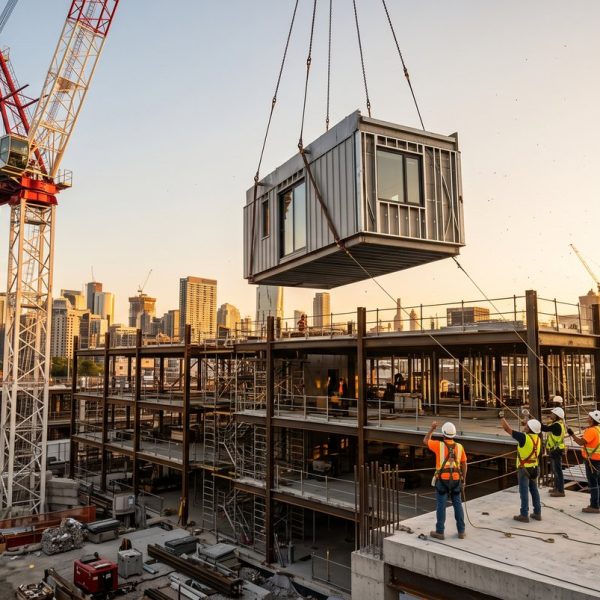
Walk past a construction site where a hotel is going up and you may see something that looks like a mistake: a crane lowering finished rooms into place, complete with tiled bathrooms, wired sockets and made beds. Nothing is being built on site at all. It is being assembled. Modular construction has spent two decades trying to shake off its reputation as cheap prefab housing, and on the projects where it is used well, it has largely succeeded.
What modular construction actually means
The principle is straightforward. Instead of building a structure in place, you manufacture volumetric units, whole rooms or sections of a building, in a controlled factory. Those units arrive on site, are craned onto a prepared foundation, and are stitched together structurally and mechanically. The finish level varies. Some modules arrive as bare shells, others arrive with cabinetry, plumbing and paint already done.
This differs from panelised or flat-pack systems, where walls and floors are made off site but assembled into three-dimensional space on site. Both fall under the umbrella of off-site construction, and the industry has broadly grouped them under the label of modular building, which has a longer history than most people assume.
Why schedules collapse in a good way
The single biggest argument is time. Because the factory works in parallel with the site, foundations, utilities and groundworks proceed while the modules are being built. Two critical paths run at once instead of one running after the other. On a well-run project, that can strip thirty to fifty percent off the programme.
Weather stops mattering. A factory does not lose a week to rain, and materials do not sit in a yard absorbing moisture. Quality control tightens, because the same crew builds the same unit repeatedly under a roof, with jigs, and with inspection at each station rather than an inspector walking a muddy site once a fortnight. Waste drops sharply for the same reason: offcuts get reused across units instead of going in a skip.
Where the savings do not appear
Modular is not automatically cheaper, and pretending otherwise has ruined more than one contractor. The factory has to be paid for. Transport costs rise steeply with module size, and an oversized load needs permits, escorts and a route survey. Craneage on a tight urban plot can be brutally expensive.
The economics work when repetition works. Hotels, student accommodation, hospitals, apartment blocks, anything with a repeating cell. A one-off bespoke house with no two rooms alike is the worst possible candidate. The other constraint is cash flow: modular front-loads the payments, because the factory wants money long before the building exists on site. Lenders who are used to drawing down against visible site progress often need educating, and this catches developers out more often than any technical issue.
There is a second contract risk that rarely appears in the cost plan: the paperwork itself when the factory sits overseas. China has become one of the largest exporters of modular units, so supply agreements, payment milestones and warranty terms are routinely negotiated between Chinese and English versions of the same deal. Developers who use professional business translation services for those documents make sure the commercial terms they priced are the terms they actually signed. It is a small line item compared with craneage, but it removes a category of dispute that no contingency allowance covers gracefully.
Design decisions get locked early
Traditional construction tolerates late changes. Modular does not. Once a module is in production, moving a wall is not a variation, it is a redesign of a manufactured product. Everything, the layout, the services routing, the fixture selections, has to be resolved before the first unit leaves the line.
Modular construction depends on components manufactured in one country and assembled in another, with tolerances that leave no room for interpretation. The specifications travelling between those sites carry the entire risk of the project. These technical translation services exist for documentation where an approximate rendering is not an option.
That discipline is a benefit for clients who can commit, and a nightmare for clients who cannot. Good modular projects invest heavily in the design freeze, run digital models to catch clashes before steel is cut, and treat the factory drawings as gospel. The projects that fail are almost always the ones where somebody kept changing their mind.
Sustainability and the whole-life view
Factory precision produces tighter building envelopes, which means lower heating and cooling loads for the life of the structure. Modules can be designed for disassembly and relocation, which a poured concrete frame never can. Layer on the wider sustainability toolkit and the case strengthens: better insulation, heat recovery, and site-level systems such as a rainwater collection system that reduces mains demand from the first day of occupation.
Verified data matters here. The LEED certification framework gives a credible, third-party way to demonstrate those gains rather than relying on a manufacturer's brochure.
If you are considering it
Choose the manufacturer before you finish the design, not after. Visit the factory. Ask what happens if a module is damaged in transit and who carries that risk. Check the crane access before you fall in love with a plot. And model the cash flow honestly, because the payment profile is the thing most likely to bite.
Modular suits firms that work across borders, since factories and sites often sit in different countries and specifications travel with the units. Getting technical documents right in more than one language is not a footnote, and PoliLingua's piece on what companies forget to translate before going global is a useful reality check for any contractor about to source from abroad.
Used on the right project, modular delivers a better building faster. Used on the wrong one, it delivers an expensive lesson. The difference is almost never the technology. It is whether the team understood what they were signing up for.